Meyer Rapier
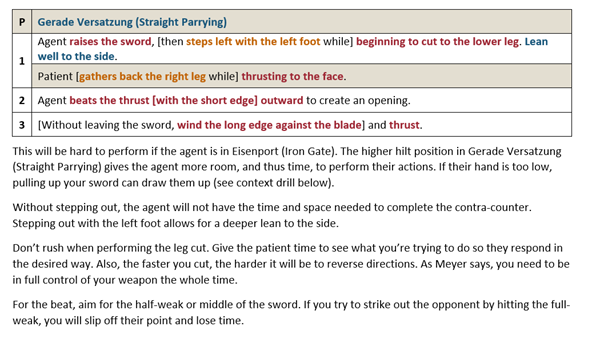
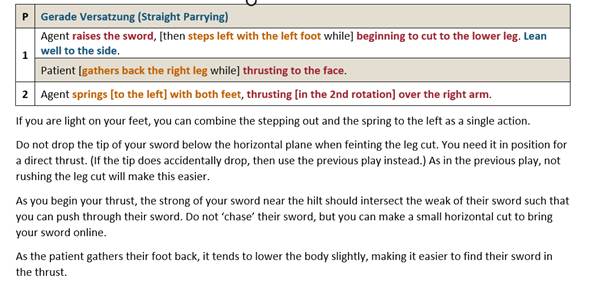
We looked at the first two leg cuts against Gerade Versetzen.
Meyer Polearms
We had three cohorts this week:
- Cohort 1 worked on Gerade Versetzen (Straight Parrying).
- Cohort 2 worked on Mittelhut (Middle Guard) and the start of Underhut (Low Guard).
- Cohort 3 worked on Oberhauw (High Cut) for the Halberd.
Here are the new material for driving with the halberd.
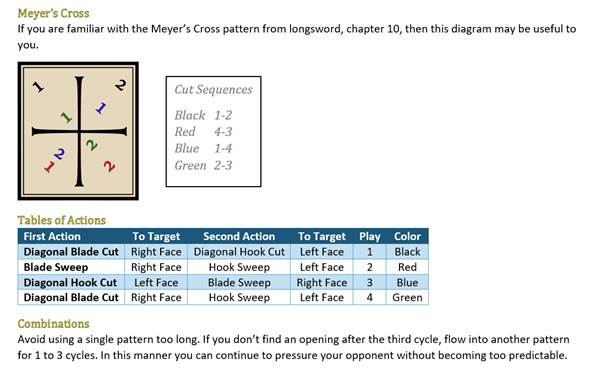
We don’t have writeups yet for the halberd’s high cut plays.
L’Ange Rapier
This week we worked on the appel, the combination beat/stomp meant to distract and intimidate the opponent. Our current pedagogical theory is that chapter 16 should be taught before 15. Chapter 16 has the appel working, 15 has the contra to the counter to the appel. It seems that the opponent won’t know to do the counter unless they’ve lost against the appel in the past, so it should come later.
Meyer Longsword
Cohort 1 worked through the basic guards, footwork, and the sword dance.
Cohort 2 worked on the Example Device 1/2 and Tag 1. This was done through a combination of slow work without gear (a.k.a “kenjutsu style”), pell work, and contact drilling with normal gear.
It is important to note that slow work without masks is not appropriate for all techniques. And since everything is done so slowly and slightly out of range, it can introduce artifacts unless you also put gear on for contact drilling.
Cohort 3
Jake and Rafael worked through these thrust drills.
Assuming you thrust from your dominant side, the responses can be categorized as follows:
Getting pushed low and off to the side = cut around from above.
A) Low commitment = snipe to arm.
B) High commitment = cut around to head.
Pushed high and off to the side = cut from below
A) Low commitment = rising from your dominant side (uncrossed zver).
B) High commitment = rising cut from non dominant side (crossed zver).
Other notes: if you’re having trouble differentiating how your opponent is parrying while in a committed thrust, honestly fight for that thrust until you feel your opponent choose.
Cohort 4
Tristan and Penelope were workshopping how to counter someone who rises into right Nebenhut after gettting krumped/or rising cut gets stuffed.
Tristan found that a short outside parry stuffs the backhand zorn that Charlie and I favor, but not the crossed arms short edge that Penelope favors (I think she rediscovered the Warstrike).
I don’t remember your exact counter, but it looked like a crossed armed zver that tracked the nebenhut user’s blade as they did their counter attack.
Additional Material
And finally, to tie what both advanced groups were workshopping together….
A workable oh shit defense against a committed thrust to crossed zver, is parry high/kron and then drop the tip into right nebenhut to catch the zver. Executing the warstrike/plunging cut similar to Penelope has a high chance of sneaking in since your opponent is liable to to go into their own hanging parry as they try to run past.
Alternatively, I think a high parry into a open zver is a tighter action, but you have there is a much lower margin of error to avoid the double.
Course renaming
Based on the research done by Jake, we’re reordering the intermediate classes for the longsword. Specifically, Meyer Longsword 2 will now contain:
- Chapter 4 & Part 3: Glossary of Cuts (Secondary Cuts)
- Chapter 5: Glossary of Handtarbeit (Handwork) <– normal binds
- Chapter 11: Brechfenster (Break Window) <– high bind
The rest of the chapter 11 will now be Meyer Longsword 3.
The reason we’re doing this is that we are seeing how Meyer is using the glossary chapters as ‘Lego blocks’ to create the longer plays we see in chapter 11.