Meyer Rapier
Our first pass interpretations of Gerade Versatzung (Straight Parrying) have been completed. For the next several weeks we’ll be continuing to test the plays and revising our interpretations accordingly.
There are 25 plays and 2 precepts in this section, so it will take awhile to go through them all. But they are all very simple and really should have been covered in Part 1 of Meyer’s book. These are the core skills that every sidesword fencer should know.
Marozzo Greatsword
After reviewing the plays from last time, we started with Assault 1, Part 2. The opening action is the same as Part 1, but from the other fencer’s side. So essentially we learned the counter to Part 1 and what follows from there.
We also looked at the 2nd true edge Stretta, which is a cross-knock followed by a pommel strike or cut. (Or grapple, as we are wont to do.)
Rada Rapier
Research into Rada’s Spanish rapier continued with a look at chapter 17. This section is described by the author as,
Things the instructor must consider before teaching the student the formation of the techniques, followed by a reminder that the atajo is the universal foundation of each of the techniques, and the requirements that must be met to work them with the perfection that is required.
L’Ange Rapier
In our L’Ange class, we reviewed the Gliding Thrusts. Our interpretation of this technique is that it is a long lunge similar to what you would see in Capo Ferro. It contrasts with what you see in most of the text, which uses a series of constraints to get close before making a more modest attack.
Then work was started on the first of two chapters on the Appel. This is a foot stomp, usually accompanied by a beat, meant to startle the opponent.
Fabris Rapier
Coincidentally the Fabris group was also working on the Appel. However, from the perspective of Fabris it is a bad technique that is only useful in limited situations against unskilled opponents. (This wasn’t the first time that Fabris looked down on common fencers and won’t be the last.)
Next up is a discussion about what makes for a good or bad feint. If you’ve read chapter 12 of Fabris, you already know what he thinks on the topic. If you haven’t… go read it. All of the discourse chapters in Fabris are well worth your time, even if you aren’t doing rapier.
Chapter 12 concludes with invitations, which will have to wait until next week.
Meyer Longsword
The longsword class was divided into three cohorts.
Cohort 1 is continuing to work through the lessons in chapter 10. This is where you’ll find the famous Meyer’s most famous pattern, to which Jonathan argues, “Meyer’s Square” is missing the point.
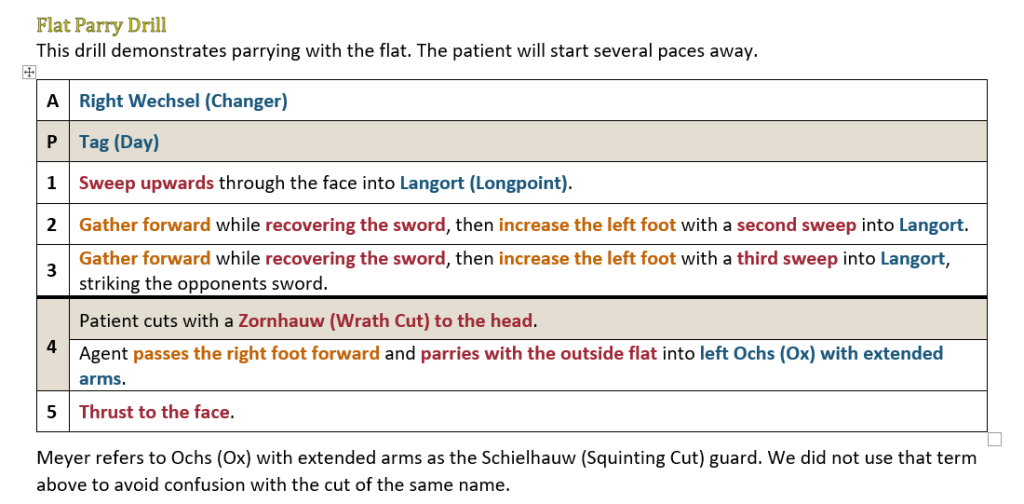
Cohort 2 demonstrated this by creating a new technique that combines the sweeps that feature in chapter 10 with a flat strike.
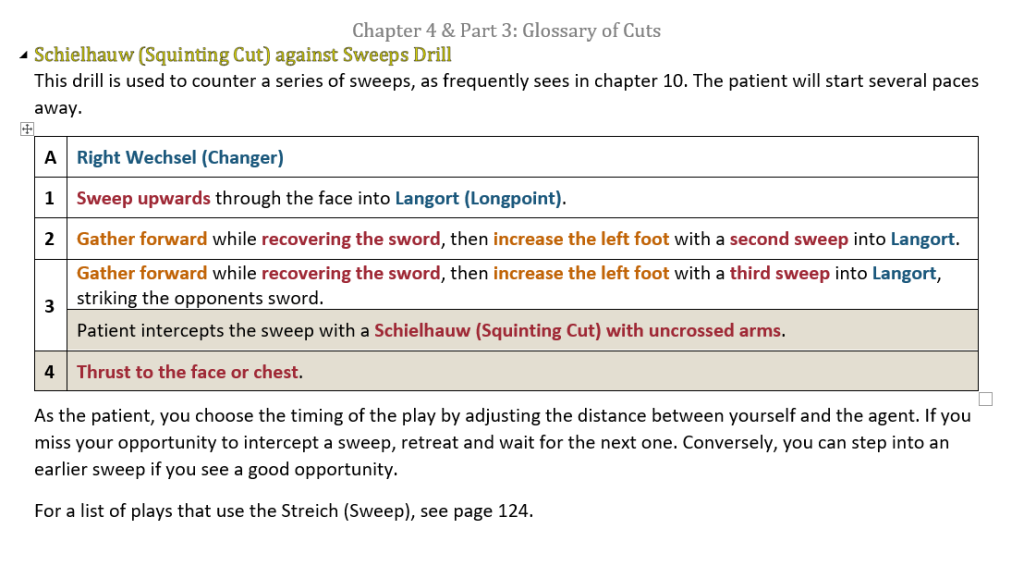
They also created a counter to the sweep.
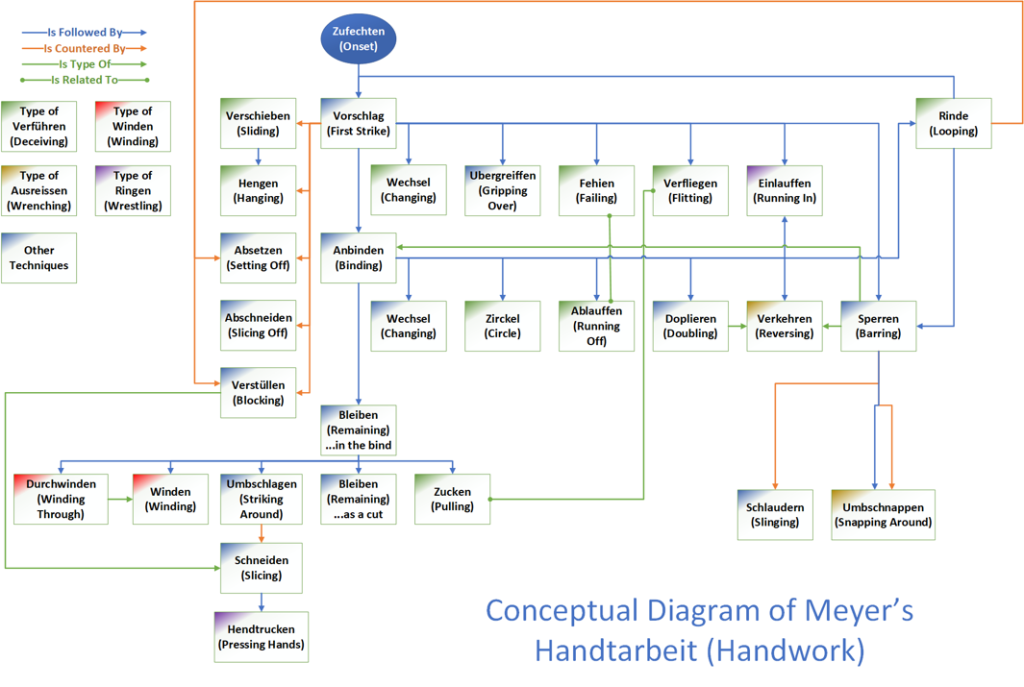
Cohort 3 began work on the Meyer’s handwork glossary. While this appears in chapter 5 of the book, we don’t teach it until the student has at least completed our level 1 program. Without those fundamentals, the student doesn’t have the context needed to properly grasp the handwork.
The handwork itself is essentially a set of ‘building blocks’ from which you can construct devices. The diagram below shows how the pieces can be connected.
Upcoming Fencing Opportunities
- Tuesday, 6:30 pm: Open Session in Rancho Bernardo <— RSVP on Discord
- Wednesday, 7 pm: Meyer Rapier (Level 1 and 2) at Allied Gardens Park
- Thursday, 7 pm: Meyer Staff and Halberd at Allied Gardens Park
- Sunday at Allied Gardens
- 11 am Rada
- 12 pm Italian Rapier (L’Ange and Fabris)
- 1:30 pm Meyer Longsword
- 3 pm Advanced Longsword