The rules for March 2026 can be found on Dropbox.
General Rules
Everyone started with 6 points. This allowed for the payment of penalties in early matches when you would otherwise not be able to.
Fechtfeder Rules
The fechtfeder (fencing feather) lists are designed to simulate historic fechtschule rules. In an actual fechtschule, injures were common and may even be required to win. But at the same time, they couldn’t be so severe that people were unable to return to work the next day. Thus some behavior such as thrusting was not permitted and is taken very seriously.
Sword Change
After handling the historic reproductions by Arms and Armory, we modified the rules to only score hits with the last 6” of the sword. This is to account for only the last few inches of the feder being sharp while still making the scoring area large enough to be visible.
The fencers reported that it wasn’t significantly harder to use that restriction, though they did have to be more aware of their measure.
Target Change
In past fechtschules, the whole body, other than hands, were allowed. So if the arm was hit when it was raised above the head then that would count as higher than the head.
After reading the historic rules more carefully, we’ve decided that only the head counts for a score. Other targets, other than hands, can be struck to create an opening.
That worked! I saw some really good arm and head combos with single sword fencing.
Where it didn’t work well was two-sword fencing. With both arms high, and separate, there often wasn’t a viable opening to the head past the arms.
There is a request to add target substitution to the rules. If your arm is in front of the body/head and is struck, it counts as hitting the body/head behind it.
Penalty Enforcement
The penalties for hand hits and thrusts were strictly enforced this year.
This had the intended effect and fencers went from ‘not trying to thrust’ to actively avoiding even accidental thrusts.
Note that accidental hand hits are a smaller penalty and can be waived by the opponent. A thrust, even accidental, immediately forfeits the match and has a 3-point penalty. This is the equivalent to completely wiping out a previous win.
Exchanges
Previously the number of exchanges would be negotiated for each match. This slowed down things and didn’t really add to the experience, so now it’s locked at 5 exchanges.
All exchanges must be fought, even if there is a clear winner after 3 passes. (This was always the rule, but wasn’t clear in the past.)
I didn’t observe any negative effects from this change.
Spada da Filo Rules
The spada da filo (edged sword) lists are meant to simulate the rules and behaviors needed to sparring with real weapons. Though the swords are not sharp, fencers shall act as if they are at all times prior to and during the bout. To reinforce the need to be in control of your weapon at all times, the penalties for mistakes are high.
Exchanges
Rather than having a set number of exchanges, fencers were asked to continue until they both felt one had showed superiority. Or they decided they were equally matched.
I’m not sure if the fencers didn’t understand the concept or if the concept is inherently bad. But either way, this led to confusion and will probably be scrapped in the future.
Penalty Enforcement
Penalties were strictly enforced this year. There was a dramatic reduction in accidental hits compared to last year.
I can’t say if there was a causal relationship or if the fencers are just getting more familiar with no-contact sparring. But either way, we’re getting the results we want to see.
Steel Greatsword Sparring
You read that right. We were the massive VB Montante (approx. 6 lbs or 2700 g) for no-contact sparring. And it worked. I saw a really clean match with only one or two instances of accidental contact.
The fencers did report that it was challenging. It isn’t easy to bring what’s essentially a momentum weapon to a hard stop so that it won’t make contact, while still making it clear that it could have it.
Something to keep in mind is that this skill is specifically part of Iberian montante training. See Montante Rule 1 is Not a Flow Drill for what I mean.
Rapier Rules
Prior to the invention of fencing masks, bouting with thrust-only rapiers was very dangerous. A rolled or button tip could still pierce an eye or break a tooth. These rules are meant to simulate that reality and the limitations it entails.
Target Change
Based on the writings of Labat and Hope, the target zone was restricted to just neck to belt. Thrusts to the arms and legs did not count.
This made the match more challenging, but not overly so. No one seemed to have any problems with the target restrictions.
Penalty Enforcement
As with the other rulesets, penalties were supposed to be strictly enforced. For this set, it means no thrusts to the face.
I did not observe any face thrusts. Perhaps I missed it, but overall the fencers, even the novices, rose to the challenge.
Double Scoring
According to Labat, you can score two touches in the same exchange if they are to different locations.
This rule didn’t seem to come up in the single-rapier matches, but with rapier and dagger I saw it being leveraged to full effect.
Touch on Withdrawal
Another rule is that you cannot score a touch on a fencer who is withdrawing from the engagement after a touch is scored.
I assume that this rule was created to clarify what you can and can’t do when trying to score a second touch on an exchange. It also all but eliminates the possibility of an after blow.
This rule did not come up in any match I witnessed.
Exchanges
As per Labat, matches were won by scoring 3 touches. In theory that means you could win with only two exchanges, but often it went to four or five.
Hand Parries
As per Labat and Hope, hand parries were banned. The only penalty, according to the source, is that you can’t score a point when making a hand parry or directly after.
The fencers just kept their off-hand behind so this rule was never tested.
Doubles
This time, doubles were scored for both fencers. (Assuming on target, no hand parries, etc.)
In the future, we may add Hope’s rule that the patient may only score a double if they make an effort to parry the agent’s thrust first. As I read it, he awards the attempt to do a parry-riposte but considers a simple retaliatory thrust to be unrealistic.
How this interacts with modern after blow rules is unclear.
Polearm Rules
We codified our polearm rules. Now cuts to the whole body are allowed, except hands. Thrusts are allowed to the whole body except hands and face.
Face thrusts have an additional special case. If you show a face thrust (i.e. spada da filo style) you score a point. But if you hit the face, you forfeit.
Note that most of our polearms have soft rubber or foam tips so the face thrusts aren’t really dangerous unless excessive force is being used. But we restrict them anyways to simulate sparring with wooden practice weapons where even a light touch to the face could cause significant injury.
With Gauntlets
This isn’t in the ruleset, but for some matches the fencers added a ‘with gauntlets’ rule that added the hands as a target.
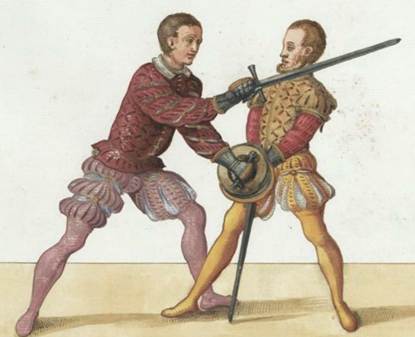
Fencing with gauntlets, but no other safety gear, is attested in Mair.
Heavy Polearms
Some of our polearms have hard rubber heads that would be inappropriate for this ruleset. For those, the spada da filo rules were used instead.
Also, some used the spada da filo rules for the challenge.
Dagger Rules
Daggers were classified as thrust-only or cut-only. This was largely a result of their construction, as some were flexible while others were hard plastic.
Cut Only
These rules were fine. The only issue we ran into was one fencer mis-understood the rule and used a thrust. It was unpleasant, but the offended fencer quickly recovered and was able to spar again after a brief rest.
Thrust Only
We were using flexible rondel daggers, but pretending like they were Meyer style wooden daggers. Which means no thrusts to the face. We defined “face” as the metal of the fencing mask, but not the rubber that goes around it.
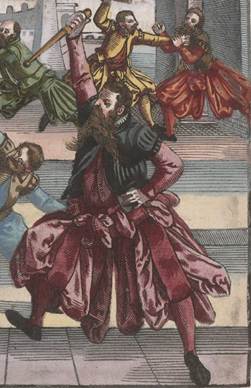
I personally had some trouble with this, as Meyer’s primary opening move is a thrust to the face over the arm. But I consider that to be a skill issue, not a rules issue.
Grappling
Grappling is optionally allowed. It didn’t come up in the matches I witnessed, mostly because people were doing a lot of two-dagger fencing that precluded our basic techniques.
Wrestling Rules
We added Irish Collar and Elbow wrestling to the list, but with the usual restriction that you’re looking for balance point rather than completed throws. It worked ok, but required a jacket so people were more interested in the other wrestling games.